Views: 0 Author: Site Editor Publish Time: 2026-04-01 Origin: Site
The modern MRE is not just a standard food product. It is the result of decades of multi-billion-dollar military logistics testing. Engineers designed these units to solve the ultimate supply-chain challenge. For institutional buyers, emergency prep planners, and outdoor organizations, understanding the history of military rations isn't just trivia. It is the foundational framework for evaluating vendor reliability. You must understand how to verify shelf-life claims and confirm nutritional efficacy.
Tracing this evolution reveals critical procurement criteria. Rations moved from heavy, inefficient canned goods to today's high-tech retort pouches. This history shows exactly what standards you must demand today. You can use these lessons to evaluate any commercial MRE meal ready to eat manufacturer. You will learn how to spot authentic engineering versus mere marketing hype.
Evolution Driven by Constraints: The shift from WWII C-Rations to modern MREs was forced by strict military constraints (weight, extreme drops, temperature volatility), setting the baseline specs for modern survival food.
The Paradigm Shift in Taste: The 1990s "Fix It!" initiative proved that caloric density is useless without palatability, making menu variety a core ROI metric for bulk purchasing.
Military vs. Civilian Sourcing: Understanding the legal and quality differences between DoD surplus and commercial civilian MREs is critical for compliant, risk-free procurement.
Evaluation Standards: True MREs must pass rigorous physical and nutritional thresholds—including specific caloric counts (1,200/meal) and verifiable shelf-life degradation curves.
Early battlefield rations suffered from a massive Total Cost of Ownership (TCO). Civil War soldiers relied on hardtack. Vietnam-era troops carried canned C-Rations. These metal cans created extreme weight burdens. Packaging vulnerabilities ruined supplies during transport. Cans lacked modularity, forcing quartermasters to ship heavy, rigid boxes across the globe.
In 1981, a massive technological shift changed logistics forever. Department of Defense researchers spearheaded the adoption of vacuum-sealed retort pouch technology. Engineers layered aluminum foil and robust food-grade plastics. They sterilized the contents under immense heat and pressure. This flexible packaging effectively eliminated biological contamination risks.
This historical breakthrough established the baseline for modern emergency logistics. Retort pouches carry no heavy metal weight penalty. They compress easily into tactical gear or disaster-relief pallets. This flexibility drastically reduces shipping and storage costs for bulk buyers. You can stockpile these packages efficiently in tight warehouse spaces.
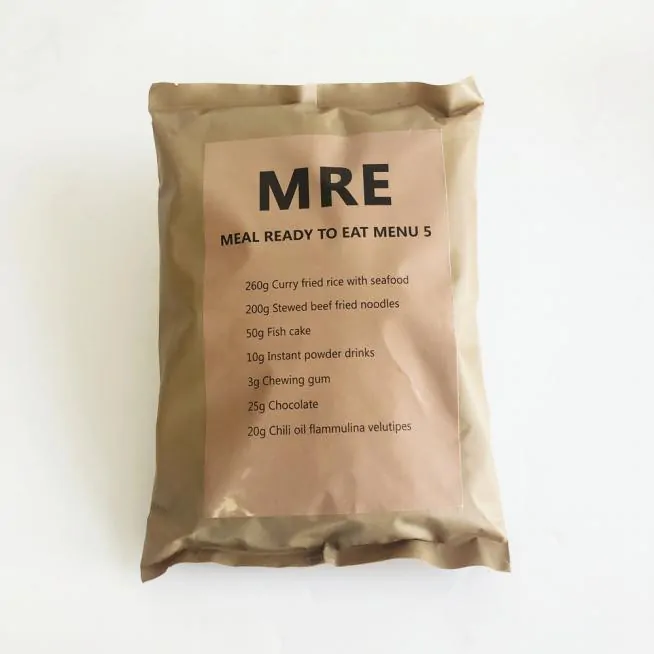
You cannot evaluate emergency food using standard grocery metrics. Military nutritional studies originally outlined a rigorous 10-constraint academic framework. This framework defines what actually qualifies as a legitimate meal ready to eat versus a standard commercial camping meal. True operational rations must survive scenarios where civilian products instantly fail.
Evaluation Metric | True Operational MRE | Standard Camping Meal |
|---|---|---|
Preparation | Fully cooked. Requires zero added water. Includes chemical heater. | Requires boiling water. Demands external fuel sources. |
Durability | Survives 1,250-foot parachute drops. | Punctures easily under moderate pressure. |
Shelf Life | Minimum 3.5 years at 27°C (80°F). | 1-2 years typically, degrades fast in heat. |
Caloric Density | Strictly 1,200 calories per unit. | Varies wildly (often 400-600 calories). |
Manufacturers must adhere to critical physical specifications to meet this framework. We evaluate durability using extreme kinetic tests. A genuine pouch must withstand a 1,250-foot parachute drop. It must survive a 100-foot freefall without seal failure. Thermal stability is equally critical. Vendors must guarantee specific shelf-life metrics. The food must remain viable for 3.5 years at 27°C. It must gracefully degrade at higher temperatures rather than spoiling instantly.
Nutrition also follows a strict baseline constraint. Engineers standardize each unit at 1,200 calories. They design this profile as a "force multiplier." It sustains human bodies during high-exertion activities in harsh environments. Buyers should demand hard data during their shortlisting process. You must require manufacturers to provide proof confirming these historical MIL-SPEC physical and thermal stress tests.
Caloric density provides no value if end-users refuse to eat the food. In 1991, early MREs faced a severe morale crisis. Troops notoriously dubbed them "Meals Rejected by Everyone." Quality fell so low it prompted direct intervention from top military brass. General Colin Powell famously held up a ration package and ordered his staff to "Fix It!"
This order sparked a massive user-centric redesign. The military abandoned its top-down "father-knows-best" nutritional approach. They launched a customer-feedback-driven continuous improvement program. Researchers expanded the options from 12 basic items to over 24 diverse menus. They realized taste directly impacts physical readiness.
These historical lessons highlight key ROI drivers for modern buyers. In civilian emergency prep or disaster relief scenarios, unpalatable food leads directly to massive waste. End-users suffer severe calorie deficiencies when they skip meals. Menu diversity maximizes consumption. Familiar comfort foods, like the historically popular "Chili Mac," maintain high morale. The inclusion of the Flameless Ration Heater (FRH) is a non-negotiable feature. Hot meals deliver vital psychological comfort during chaotic disasters.
Implementation considerations require careful market navigation. The Y2K panic and Hurricane Katrina birthed the legitimate civilian market. These events forced citizens to realize the necessity of robust emergency stockpiles. However, this surge also created distinct sourcing hazards.
You must actively avoid the gray market trap. Many unauthorized vendors sell "authentic military surplus" online. This presents severe compliance and security risks. Sellers often resell U.S. Government property illegally. Furthermore, surplus pallets frequently suffer improper storage. Vendors abandon them in extreme heat environments. They sell them just weeks before expiration. This compromises your emergency readiness entirely.
Selecting a reliable partner requires strict shortlisting criteria. Follow these steps when vetting suppliers:
Verify the source: Differentiate between Tier 1 legacy military contractors and lesser-known direct-to-consumer (D2C) brands. Legacy contractors often produce highly compliant civilian lines.
Check for date transparency: Legitimate commercial options offer clearly printed, transparent date codes. Avoid products utilizing obscure Julian dates meant to confuse buyers.
Audit the chain of custody: Demand guaranteed climate-controlled logistics. Heat destroys shelf life faster than any other factor.
Review nutritional optimization: Civilian brands often optimize sodium and fat levels. They engineer these profiles specifically for non-combat disaster scenarios, suiting stationary civilians better than high-sodium combat equivalents.
Looking at current military lab initiatives helps us understand the next wave of commercial features. The modern view categorizes the end-user as a "tactical athlete." This shift continually drives exciting nutritional upgrades.
Researchers focus heavily on mental resilience. They are incorporating Omega-3 fatty acids directly into the entrees. They also add advanced gut-microbiome support via stable probiotics. These additions actively mitigate physiological stress during extreme scenarios. They keep users focused and healthy.
Packaging innovations represent the next major operational leap. Bulk deployment inherently creates massive waste-management footprints. Discarded plastic wrappers choke disaster zones. Labs now push aggressively for durable, biodegradable packaging. They want pouches capable of surviving a 100-foot drop but dissolving harmlessly in soil months later.
Emergency planners must take specific next-step actions. You should evaluate vendors beyond current MIL-SPEC adherence. Investigate their active R&D pipeline. Seek partners developing modular, low-waste, and nutritionally advanced ration systems. They will future-proof your organization's preparedness strategy.
The history of military rations proves one undeniable fact. Emergency food procurement requires balancing extreme physical durability alongside high user acceptance. You cannot sacrifice taste for shelf life. You cannot sacrifice packaging integrity for cost savings.
We strongly recommend updating your procurement strategies immediately. Stop evaluating rations based purely on "calories per dollar." This metric ignores vital spoilage risks. Use the military's hard-won historical lessons instead. Assess thermal stability data accurately. Verify packaging drop-test integrity. Ensure a clean, legal chain of custody before you commit your budget to any bulk manufacturer.
A: Shelf life depends entirely on storage temperature. Stored at 27°C (80°F), packages last roughly 3.5 years. Stored in colder environments (15°C/60°F), they can remain viable for over 5 years. Extreme heat degrades them rapidly, dropping viability to mere months. They do not last forever.
A: It is generally illegal for individuals to commercially resell authentic U.S. military-issued rations. The packaging distinctly states they are government property. You should purchase purpose-built commercial civilian alternatives. They offer guaranteed legality, better storage history, and optimized nutrition.
A: The Department of Defense officially introduced the modern Meal, Ready-to-Eat in 1981. It replaced the heavy, canned MCI (Meal, Combat, Individual) and C-Rations used previously. It utilized the revolutionary vacuum-sealed retort pouch to reduce weight.
A: The heater utilizes a simple chemical reaction. The pad contains finely powdered magnesium and iron. Adding a small amount of water triggers an exothermic oxidation reaction. This reaction rapidly releases heat, bringing the food pouch to optimal serving temperatures within ten minutes without any fire.


